


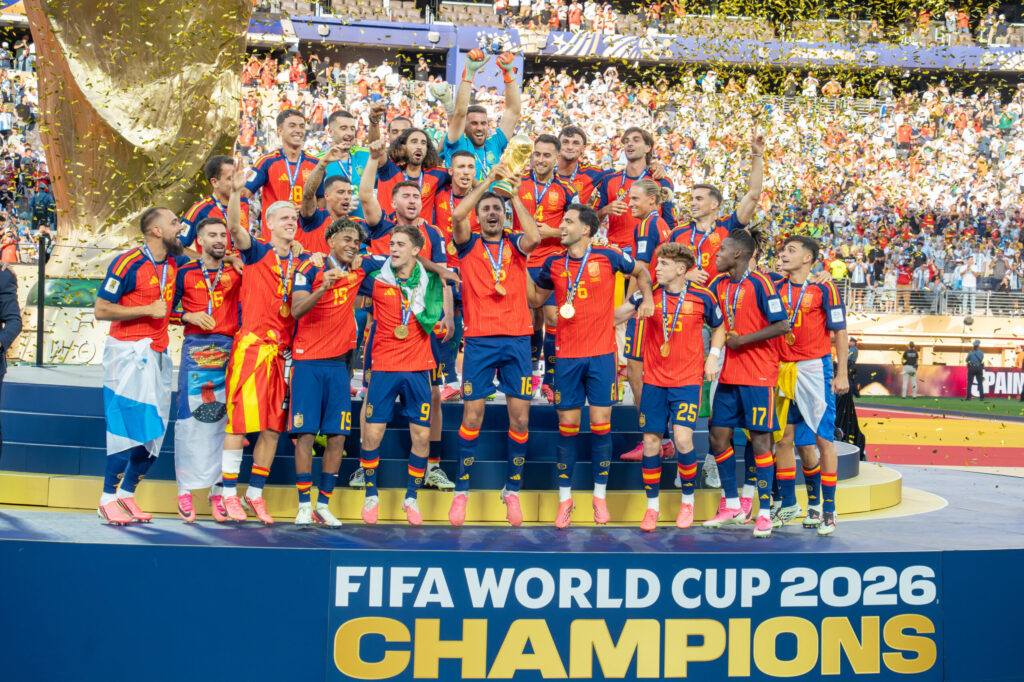
Photo: Bryan Berlin / Wikimedia Commons, CC BY-SA 4.0 — Spain lifts the World Cup trophy, July 19, 2026.
Spain won it in extra time — 1-0, Ferran Torres scoring in the 106th minute. Argentina failed to register a single shot until the second half of overtime, and the match stats point to a one-sided final that was only settled by the resilience of Messi’s team defense. Spain’s second World Cup title in history — and the third straight knockout round in this tournament where the market underrated this exact team.
How the final played out: 20 shots to 2
The numbers from the final look lopsided for a 1-0 game. Spain held 65% possession, took 20 shots (12 on target) against Argentina’s 2, won 9 corners to 4, and outperformed their opponent in xG — 1.94 to 0.22. Argentina didn’t manage a single shot on Spain’s goal until the second half of extra time.
That kind of statline at 1-0 is a familiar story for a team whose performance deserved a bigger win but ran into a well-organized defense and a strong goalkeeper. Extra time only confirmed what had been building all match: Spain kept creating chances, Argentina defended and waited for a shot that never came.
| Stat | Spain | Argentina |
|---|---|---|
| Possession | 65% | 35% |
| Shots (on target) | 20 (12) | 2 (0) |
| xG | 1.94 | 0.22 |
| Corners | 9 | 4 |
Torres’ goal: the 106th-minute winner
Ferran Torres scored the match’s only goal in the second period of extra time — Spain had been pressing Argentina’s defense throughout overtime, and the breakthrough came 15 minutes before a potential penalty shootout. For Argentina, this marked the third straight World Cup knockout match decided against them in extra time — not the first time Scaloni’s side has found itself in that exact situation in a decisive game.
Messi’s 1 shot in 120 minutes vs. Yamal, the final’s biggest star
The final will be remembered for more than the scoreline. Two players separated by more than 20 years in age started the same World Cup final for the first time in tournament history — Lionel Messi (38) and Lamine Yamal (19). Messi managed a single shot all match, which struck Mikel Merino in the face, and touched the ball just 54 times — one of the lowest totals of his World Cup career. Yamal, by contrast, was the most dangerous player on the pitch from the opening minute and became the first teenager in history to win both the Euros and the World Cup.
For Argentina, this was likely Messi’s last realistic shot at a World Cup title as a starting player — and the stats suggest the team couldn’t build its game through its captain in the tournament’s decisive match.
The market and the public money disagreed — and the market was right
As we covered in our final preview, the line opened at Spain -164, Argentina +134, with three-way odds of Spain +130, Draw +195, Argentina +260 — Spain were favorites. Yet 58% of bets by money went to Argentina: sportsbooks saw a clear skew toward Messi’s team, despite a line that opened in Spain’s favor.
It’s a textbook case of bet percentage diverging from the closing line: public money chased the storyline (“Messi’s last shot”), while the bookmakers’ line held on structural factors — possession control, defensive solidity, squad depth. Spain didn’t just win the match, they won it with a clear on-pitch edge that validated the original line. This is now the third instance in the tournament where the final result confirmed the odds rather than the betting split — the same pattern played out in the quarterfinal and semifinal involving Norway.
Spain’s second title in history
Spain wins the World Cup for the second time, following their 2010 triumph. Combined with the Euro 2024 win, the national team claims back-to-back major international trophies, and Yamal already holds both titles at age 19 — a first in football history.
Where to bet on football
Betting lines on top football events are available through major casino platforms:
- 1Win Casino — wide football betting line / visit site →
- 1xBet — live betting and a large market selection / visit site →
- BC.Game — betting with crypto deposits / visit site →