


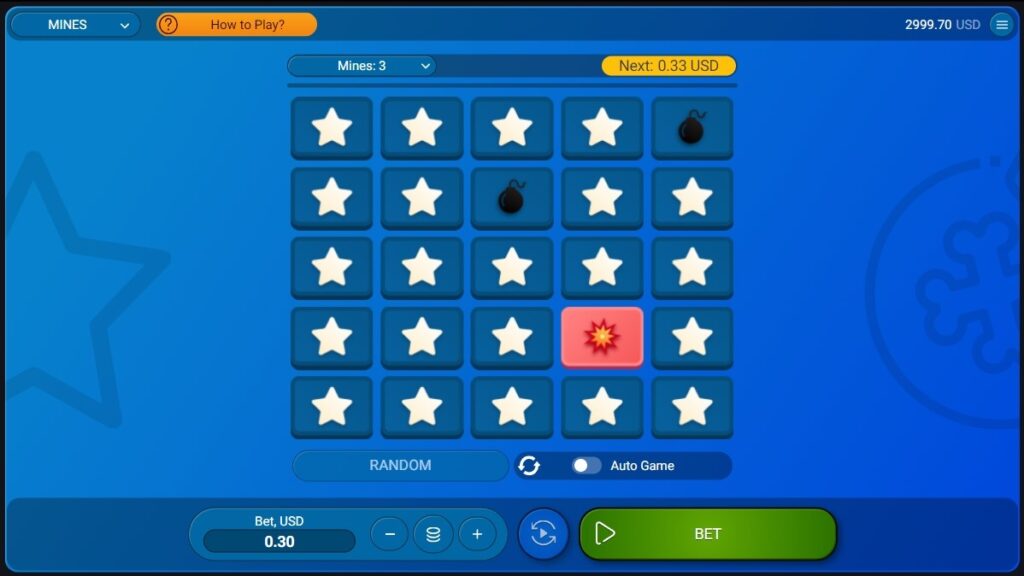
Mines by Spribe is one of the few crash games where the player genuinely controls their own risk rather than just watching a multiplier climb. A 5×5 grid, you choose how many mines are hidden, and you decide when to walk away. When I worked in casino support, Mines generated far fewer complaints than slots — precisely because players understand the mechanic and feel in control. The catch is that “control” is just as much of an illusion if you don’t know the math behind it.
This article covers specifics: how many mines to pick, when to cash out, and how to avoid burning through your bankroll in the first 20 rounds. No promises of winnings, because those promises don’t exist.
Mechanics: What Actually Happens Each Round
Before the round you set your stake and choose the number of mines — from 1 to 24 out of 25 tiles. Once you hit Bet, the game generates the mine placement (hidden from you) and locks in the outcome. Then you flip tiles one at a time:
- Star → multiplier grows, keep going or cash out.
- Mine → stake lost instantly, round over.
- Cash Out → receive (stake × current multiplier).
Key point: the round result is determined before you start flipping tiles. This is not roulette where the ball spins in real time — everything is decided upfront. That is why tactics like “I feel the next tile is safe” are pure self-deception.
RTP is 97%. For crash games this is good — the house edge is just 3%. Volatility is very high, meaning frequent zero-return rounds and rare large payouts.
How Many Mines to Choose: Three Working Modes
This is the main lever in Mines. The mine count determines both the probability of surviving to the next tile and the multiplier it awards.
1–3 Mines — Conservative Mode
With 1 mine the probability of flipping the first safe tile is 96%. The multiplier is ~1.05x. To exit at 2x you need to open around 13–14 tiles in a row. Boring and slow, but losses stay minimal.
Where it works: when learning, when you want to understand the game rhythm without real bankroll risk.
5–7 Mines — Balanced Mode
The working range for most players. With 5 mines, rough benchmarks:
| Tiles opened | Multiplier | Approx. chance |
|---|---|---|
| 1 | ~1.25x | ~80% |
| 3 | ~2.0x | ~51% |
| 5 | ~3.5x | ~31% |
| 8 | ~8x | ~11% |
| 10 | ~15x | ~5% |
Most experienced players use 5–7: multipliers are attractive enough and the chance of reaching 3–5 safe tiles is not catastrophically low. The key is deciding in advance how many tiles you open and always exiting at that point.
15+ Mines — Aggressive Mode
With 20 mines there are only 5 safe tiles on the board. Flipping the first one has a 20% chance but immediately gives ~5x. Three safe tiles in a row — already 50–100x.
Honestly: most rounds in this mode end on the very first tile. When I was in the VIP department and saw large Mines payouts, it was almost always 15–20 mines and a streak of 3–4 successful rounds in a row. Rare, but spectacular. Works only with a strict session limit and iron cash-out discipline.
Cash-Out Strategy: When to Pull the Trigger
Choosing the mine count is half the job. The other half is cash-out discipline — this is where most money is lost.
Fixed Exit by Tile Count
Decide in advance: I open N tiles — I always exit. For example, 5 mines, exit after the 5th tile (~3.5x). No exceptions. This removes the main trap: “just one more.” In support, every other Mines ticket started with “I was already up 3x, decided to open one more…”
Auto Cash-Out
Mines has an auto cash-out feature — set a target multiplier and the game exits automatically when it’s reached. Recommended for anyone who knows they tend toward “one more tile.”
Adaptive Exit by Session Goal
Exit when accumulated session winnings reach your target (e.g. +50% of session limit). Requires pre-written boundaries — otherwise the “goal” shifts with the result.
Bankroll Management in Mines
Very high volatility is not a marketing label. A streak of 7–8 losses in a row with 5 mines is normal, not an anomaly. Bet 10% of your bankroll per round and one such streak wipes the deposit.
- Stake size — no more than 1–2% of bankroll per round.
- Session limit — no more than 10% of bankroll per session.
- Stop-loss — lost 50% of session limit → exit, no debate.
- Take-profit — reached +50–100% of session limit → exit too.
- No chasing — hit stop-loss → don’t top up in the same session.
On martingale (doubling stake after a loss): with very high volatility, a streak of 8 losses turns a $1 stake into $256. No real bankroll survives long enough for the system to “recover.” Martingale in Mines is a fast way to lose everything.
Provably Fair: Verifying the Game Is Honest
Spribe uses provably fair — a result-verification technology. The scheme: before the round the server generates a server seed and shows you its hash. You confirm your client seed. After the round the server reveals the full seed — you verify the hash matches. This guarantees the casino could not alter the outcome after seeing your bet. You can verify directly in the game interface under settings.
Mistakes That Drain the Bankroll
- “Hot field” — previous rounds have zero effect on the next. There is no such thing as “warming up.”
- Raising stakes after a win — “I’m up, I can risk more.” A classic shift that returns all gains to the house.
- Playing without a pre-set exit — “just one more tile” sounds harmless. On the 15th repetition it’s a different story.
- Maximum risk from the first round — 20 mines with no understanding of the mechanic almost always means an empty wallet in 10–15 minutes.
- Playing under a bonus with wagering — a 40–50x wagering requirement on crash games with 97% RTP is a trap, not a gift.
Where to Play Mines
Mines by Spribe is available at most casinos carrying this provider. From our ratings:
- Stake Casino — Mines available immediately, no extra steps. Go →
- 1Win Casino — wide crash game selection, accepts local currencies. Go →
- BC.Game — Mines in the catalogue, demo mode available without registration. Go →
- FortuneJack — full Spribe lineup, crypto. Go →
Bottom Line
Mines is an honest game with a solid RTP and genuine risk control. You cannot beat it mathematically, but the gap between deliberate play and chaotic play is very real over distance. Mine count, cash-out point, session limits — those three variables are actually in your hands.
Start on demo, find your mine count, write down your exit rules — then move to real money. Game page: Mines by Spribe — rules, strategies, casinos →