

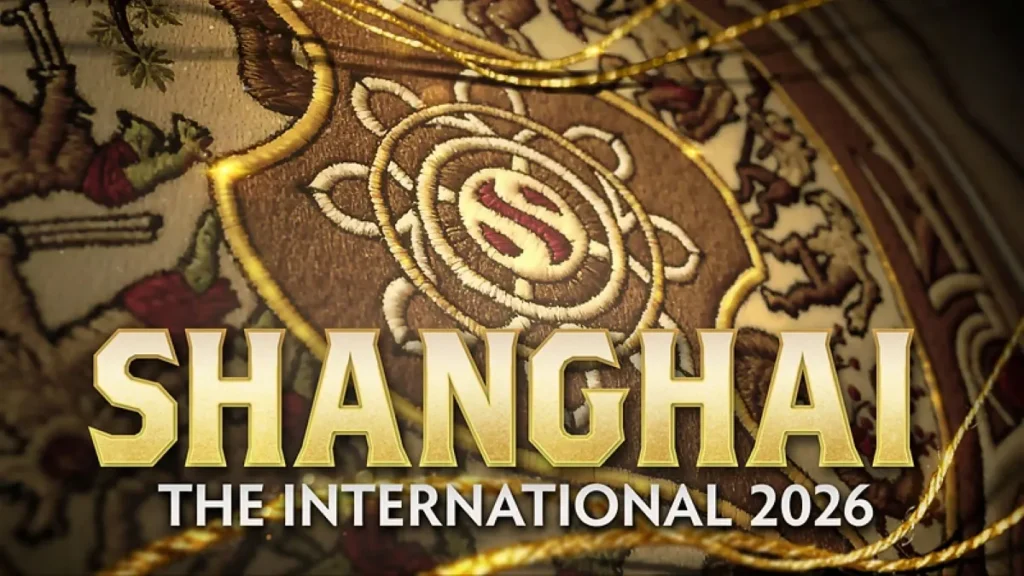
The International 2026 is the fifteenth Dota 2 World Championship and the defining event of the esports calendar. TI15 returns the tournament to Shanghai for the first time since the legendary TI9 seven years ago, and promises to test reigning champion Team Falcons as they defend their title in a country that has not lifted the Aegis since 2016.
Dates, Venue, and Format of TI 2026
The tournament will be held at the Oriental Sports Center in Shanghai, China — the very arena where OG won their second Aegis in 2019. Full event schedule:
| Stage | Dates | Format |
|---|---|---|
| Open Qualifiers | June 9–12, 2026 | Open regional qualifiers |
| Regional Qualifiers | June 15–28, 2026 | Regional brackets, fighting for TI slots |
| Road to TI (Swiss Group Stage) | August 13–16, 2026 | 16 teams, Swiss system → top 8 advance to playoffs |
| Main Event | August 20–23, 2026 | Playoffs, double elimination, Grand Final |
TI15 will feature 16 teams: some receive direct invites based on DPC season performance, the rest qualify through regional brackets. The group stage uses the Swiss system: each team plays until they reach three wins or three losses, with the top eight advancing to the Main Event.
Teams and Invites: Who to Expect at TI 2026
The full participant list will be confirmed after the Regional Qualifiers, but the picture of likely direct invite recipients is already taking shape.
Team Falcons are the reigning world champions. At TI 2025 they defeated Xtreme Gaming in the grand final and now return as the primary target for the entire field. Defending a title carries psychological weight, but Falcons have demonstrated they can win when it matters most.
Tundra Esports had the strongest regular season of any team: four S-tier titles — a result that leaves no doubt about their direct invite status. The team has been consistent and stable throughout the year, which at TI is a critically important quality.
Aurora are one of the top invite contenders after a standout season: victory at FISSURE Universe Episode 8, runner-up at DreamLeague Season 28, and runner-up at PGL Wallachia Season 8. Aurora consistently show the ability to reach finals at top-tier events — precisely what matters when direct invites are distributed.
Xtreme Gaming finished second at TI 2025 and carry the weight of Chinese expectations: China has not taken the Aegis since Wings Gaming won the trophy in Seattle in 2016. A home arena in Shanghai adds both pressure and motivation in equal measure.
Prize Pool: Record History and Battle Pass Mechanics
The base prize pool for TI 2026 is $1,600,000. However, the final figure will be significantly higher: Valve traditionally directs 25% of Battle Pass revenue into the tournament prize pool.
The history of prize pool growth vividly shows just how much the community shapes the scale of the event:
- TI3 (2013) — approximately $2.9M: the first crowdfunding experiment via the Compendium
- TI7 (2017) — $24.7M: the tournament cemented its status as the richest in esports
- TI10 (2021) — $40.018M: the all-time record in esports history
- TI 2025 — a return to more moderate figures after changes to the monetization model
The winner historically receives around 45% of the total pool — at even $20M, that works out to roughly $9M for first place.
Betting on Dota 2: Why The International Is Different
TI is an atypical tournament for esports betting and demands a distinct approach. Several key factors:
Pre-tournament patch. Valve traditionally releases a major balance update shortly before TI. Teams have minimal time to adapt, and regular-season favorites can lose their edge if the meta shifts against their style. Study patch notes and each team’s playstyle — flexible rosters with wide hero pools have historically performed better at TI.
Long breaks between stages. The gap between Road to TI (August 13–16) and the Main Event (August 20–23) is four days. Teams use that time to recover, rework drafts, and study future opponents. A team’s form in the group stage does not always carry over to the playoffs.
Double-elimination format. The Main Event uses double elimination: a team in the lower bracket can travel from their first loss all the way to the grand final, building form as they go. This makes underdogs more dangerous than their odds suggest.
The psychological factor. TI is the only tournament where players cry after losing. The mental state of a roster, a team’s history at The International, and their ability to handle pressure influence results more than at any other event. Dota 2 betting during TI requires accounting for these intangible factors alongside statistics.
High odds volatility. Bookmakers are cautious with TI lines due to the tournament’s unpredictability. This creates opportunities for value bets on underdogs in early rounds — especially if the patch has worked against the favorites.
Where to Play
Official broadcasts on PGL Dota’s Twitch and YouTube channels, as well as Steam TV. TI 2026 betting is already opening at leading bookmakers:
- 1xBet — one of the widest Dota 2 lines, live TI match betting / go to site →
- BC.Game — crypto platform with full esports coverage / go to site →
- Stake Casino — live betting on major esports tournaments / go to site →
- 1Win Casino — esports section + crash games / go to site →